
MARKET ALERT | COMMODITIES & MONETARY POLICY
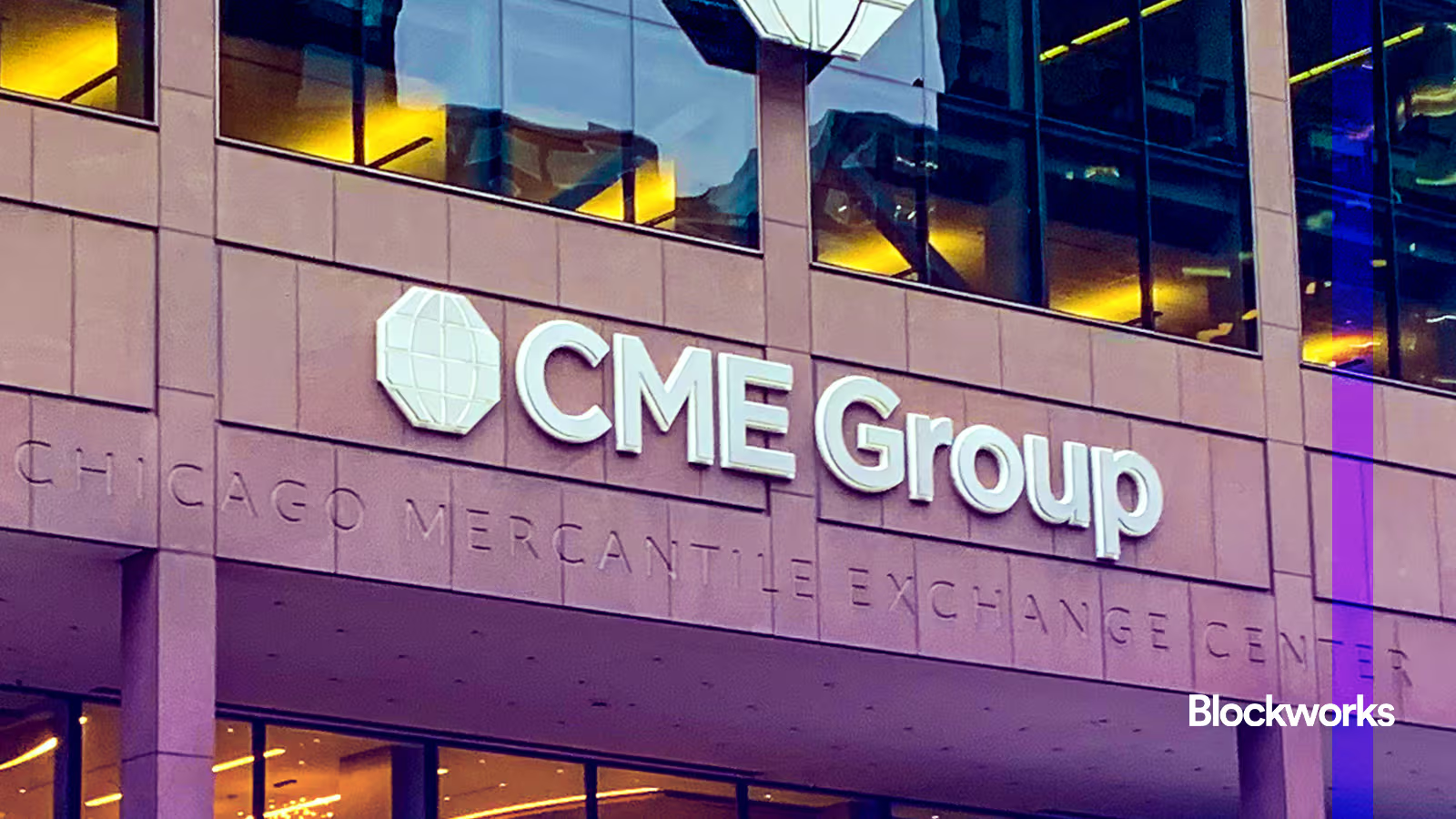
In a move that has sent shock waves across trading floors worldwide, the CME Group has officially slashed margin requirements for gold futures and silver futures contracts. This decisive intervention arrives precisely as surging oil prices upend financial markets and aggressively reshape Fed rate-cut expectations. For traders, institutional investors, and macroeconomic watchers alike, understanding the full weight of this development is not optional. It is essential.
The CME Group’s decision to reduce initial margin requirements for gold futures and silver futures is not arbitrary — it is a calculated, market-stabilizing response to escalating volatility across the commodities complex. When CME slashes margin requirements, it lowers the capital threshold traders must post as collateral to hold open positions. In turn, this mechanism, when deployed strategically, injects liquidity into a market under stress. It also prevents disorderly liquidations.
Gold futures have been trading in a state of elevated turbulence, with spot prices oscillating sharply as investors process conflicting signals from energy markets and central bank communications. Silver futures, often treated as gold’s more volatile sibling, have experienced even wider intra-day swings. By reducing margin requirements at this juncture, the CME is effectively opening the gates for a fresh wave of participation. This includes speculative retail traders and large hedge funds looking to re balance their commodity exposure.
At the heart of today’s market storm sits a single, inescapable variable: surging oil prices. Crude benchmarks have climbed aggressively over recent weeks, fueled by a combination of OPEC+ supply restraint, elevated geopolitical tensions across energy-producing regions, and a tighter-than-expected global demand picture. Surging oil prices do not operate in a vacuum — they radiate inflationary pressure throughout the entire economic ecosystem.
When energy costs spike, transportation, manufacturing, and food production costs follow. Core inflation readings, which the Federal Reserve monitors with surgical precision, become harder to suppress. Consequently, this creates a direct feedback loop. Surging oil prices raise inflation expectations, which in turn forces a re-calibration of Fed rate-cut expectations. This is the critical variable currently driving behavior in both bond markets and precious metals.
Earlier this year, the consensus on Wall Street was crystallizing around a clear narrative: the Federal Reserve was preparing to pivot, and multiple interest rate cuts were on the horizon. However, that narrative is now under serious siege. Surging oil prices have introduced a stubbornly inflationary wildcard that policymakers cannot dismiss. As a result, traders are forced to aggressively reprice Fed rate-cut expectations across the futures curve.
Federal funds futures contracts now reflect a materially delayed and reduced path of rate reductions compared to forecasts from just sixty days ago. The market is pricing in fewer cuts, starting later, with more uncertainty around each individual decision. This shift in Fed rate-cut expectations carries enormous downstream consequences for gold futures and silver futures. Both of these are acutely sensitive to real interest rate movements. When rate cuts are pushed out, the opportunity cost of holding non-yielding assets like gold increases — historically a headwind. Yet gold has defied this conventional wisdom in the current cycle. It remains buoyed by safe-haven demand, central bank accumulation, and the very uncertainty that makes rate forecasting so treacherous.
The practical implication of reduced margin requirements for gold and silver futures trading is straightforward: capital efficiency improves dramatically. Traders who previously needed, say, $12,000 to control a single gold futures contract may now require meaningfully less. This is not merely an accounting adjustment — it is a market structure event that alters the competitive dynamics between retail participants, proprietary trading firms, and institutional players.
Increased access to gold and silver futures trading could accelerate open interest growth on both the long and short side, deepening market liquidity at a time when price discovery is critically important. Moreover, analysts at several major brokerages have noted that the move could also encourage spread trading strategies — for instance, gold-silver ratio trades — which capitalize on the relative performance divergence between the two metals.
In an environment where surging oil prices, shifting Fed rate-cut expectations, and macro uncertainty converge simultaneously, market volatility hedging has moved from a supplementary strategy to an outright necessity. Gold has long served as the world’s premier market volatility hedging instrument. The CME’s decision to slash margin requirements only reinforces its accessibility as a portfolio tool.
Silver, while more industrially exposed than gold, also benefits from increased market volatility hedging demand when investor anxiety is elevated. The dual nature of silver — part monetary metal, part industrial input — makes it a uniquely nuanced hedge in an environment where both inflation fears and economic growth uncertainty coexist. Institutional investors deploying market volatility hedging strategies via futures are now better positioned to execute. Importantly, they can do so without straining their collateral books.
The CME’s decision to slash margin requirements for gold futures and silver futures arrives at one of the most consequential macro junctures in recent memory. With surging oil prices applying fresh inflationary pressure and Fed rate-cut expectations being rolled back sharply, market volatility hedging demand is surging across asset classes. Consequently, precious metals futures sit at the very epicenter of the most important investment debate of 2025.
Whether you are a seasoned commodities trader or an investor newly exploring gold and silver futures trading as a portfolio diversifier, this is a moment that demands attention. The rules of engagement are changing — and those who understand why CME slashes margin requirements, how surging oil prices feed back into monetary policy, and what revised Fed rate-cut expectations mean for precious metals will be the ones best equipped to navigate what comes next.